

Specific PET scan for TB for more effective treatment
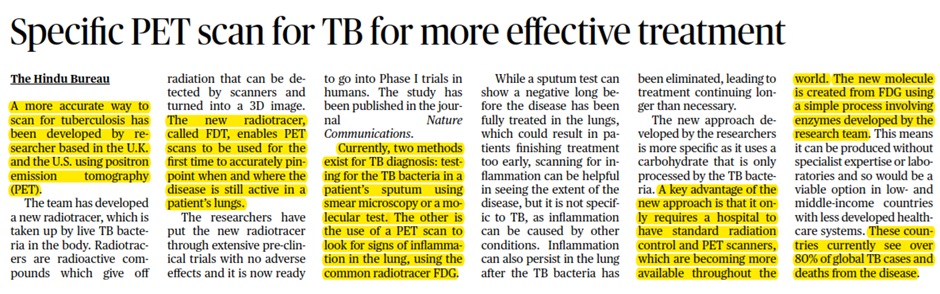
- A more accurate way to scan for tuberculosis has been developed by researchers based in the U.K. and the U.S. using positron emission tomography (PET).
Highlights:
- The team has developed a new radiotracer, which is taken up by live TB bacteria in the body.
- Radiotracers are radioactive compounds which give off radiation that can be detected by scanners and turned into a 3D image.
- The new radiotracer, called FDT, enables PET scans to be used for the first time to accurately pinpoint when and where the disease is still active in a patient’s lungs.
- The researchers have put the new radiotracer through extensive preclinical trials with no adverse effects and it is now ready to go into Phase I trials in humans. The study has been published in the journal Nature Communications.
- The new approach developed by the researchers is more specific as it uses a carbohydrate that is only processed by the TB bacteria.
- A key advantage of the new approach is that it only requires a hospital to have standard radiation control and PET scanners, which are becoming more available throughout the world.
- This means it can be produced without specialist expertise or laboratories and so would be a viable option in low- and middle-income countries with less developed healthcare systems. These countries currently see over 80% of global TB cases and deaths from the disease.
Prelims Takeaway:
- TB
- Nikshay