

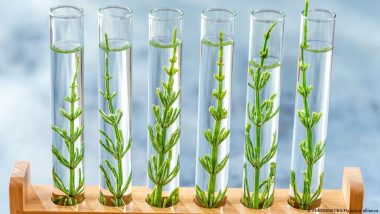
Can GM crops promise food security?
- A new “gene revolution” is being heralded as a cure-all for a growing global appetite as food systems are decimated by extreme weather.
- Farmers have cross-bred fruits, grains or vegetables to create tastier or higher-yielding hybrids for millennia.
- But it wasn’t until the 1970s that scientists first employed bioengineering to transfer genes from one organism to another to produce transgenic crops.
GM crops and changing climate
- When these genetically modified organisms (GMOs) first hit shelves in the 1990s, they were dubbed Frankenstein foods.
- Resistance to GMO crops was based on a continuing public fear that they’re harmful to human health.
- Now in the 2020s, a new gene revolution, whereby DNA can be genetically edited without splicing in genes from a separate organism, is bolstering biotech crop industry claims that it can ensure food security for a global population expected to approach 10 billion by 2050.
- The World Economic Forum (WEF), says that research into new rice, maize, wheat, potato and cassava strains, for example, will further help these vital food staples survive extreme weather and “new climate-induced diseases” in a warming world.
- One US-based research project is also helping to optimize photosynthesis so plant staples like maize and rice can better convert sunlight, water and carbon dioxide into energy to improve yields while also reducing atmospheric carbon.
Criticism
- Many scientists and environmental campaigners don’t agree that GM crops can promise food security or help fight the climate change-induced extreme droughts and floods that are decimating agriculture.
- Currently, food systems generate around one-third of the greenhouse gas emissions fuelling climate change.
- In the US, more than half of harvested cropland is produced with genetically modified seeds.
- Kenis’ research argues that GMOs often involve “large-scale monocultures” of limited crop varieties that also require great amounts of artificial fertilizers, pesticides and irrigation.
- It’s a very energy-intensive system in terms of the input it needs to function.
- So far, this system has also failed “to feed large parts of the population in different parts of the world
- At least 250 million people in nearly 60 countries endure crisis-level food insecurity, according to the World Food Programme (WFP).
Exceptions
- In the context of smallholdings in southern Africa, “insect resistant” crops in Southern Africa are a godsend to these farmers.
- Australian scientists are also spearheading a cowpea production project by bioengineering “built-in” insect pest protection since the legume has been a dietary staple across Africa for millennia.
- Without insect resistance, they get no crop in many cases,
- Despite the rising potential of new GM crops, resistance to gene manipulation continues as does skepticism, with around half of people polled globally in 2020 believing GMOs are unsafe to eat.