

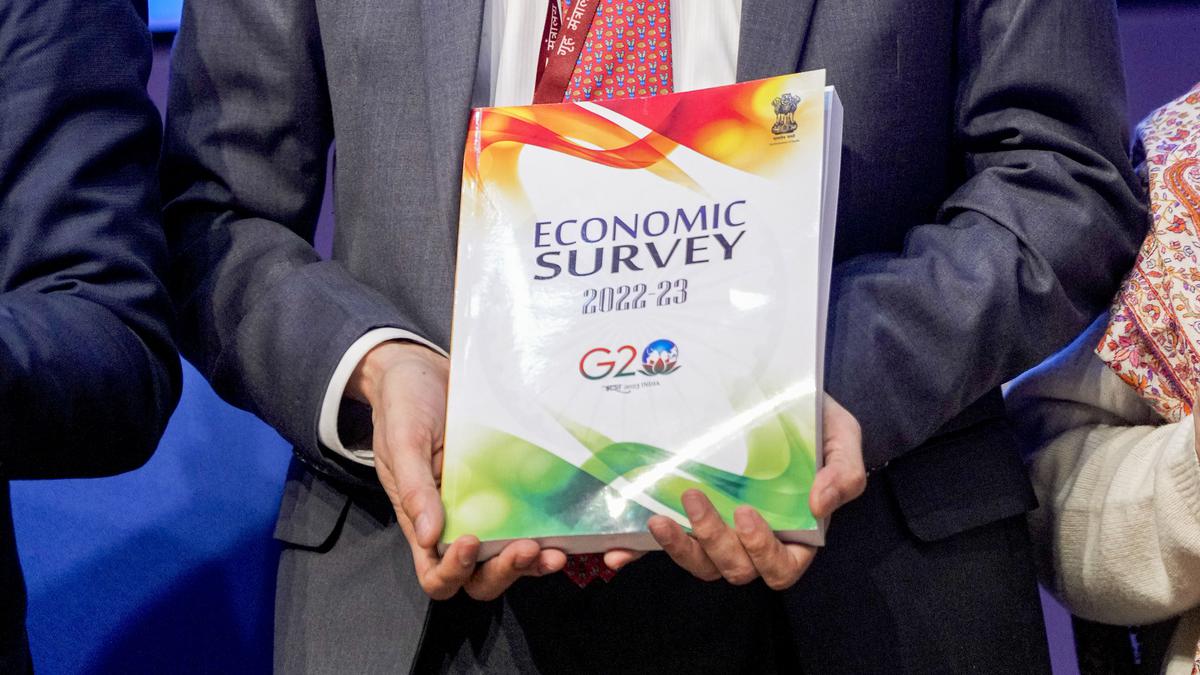
The Economic Survey of 2022-23
- Recently, the government tabled the Economic Survey 2022-23.
- The Survey laid out the outlook for India’s growth, inflation and unemployment in the coming years.
Economic Survey
- A detailed report of the national economy for the year along with forecasts.
- Comments and Policy solutions are non-binding on the government.
- Prepared by: Economic Division, Department of Economic Affairs (DEA)
Key Takeaways of Economic Survey 2023
- GDP growth:
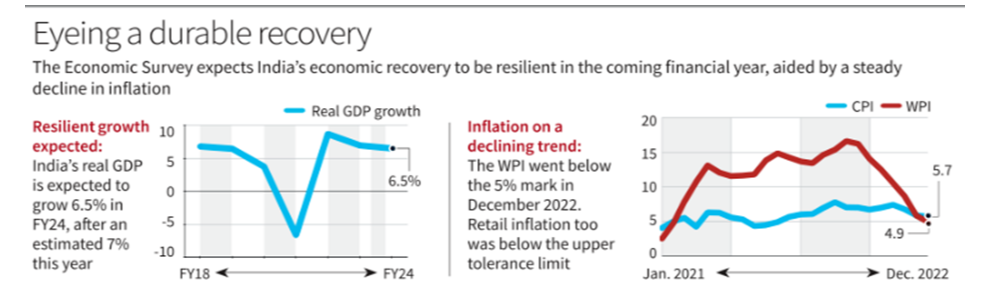
- The survey has highlighted that despite the global economic slowdown, India’s GDP would grow 6.5% in 2023-24, supported by solid domestic demand and a pickup in capital investment.
- Estimated to be higher than for almost all major economies.
- Survey louded the growth trajectory between 6.5 and 7.0% despite strong global headwinds and tighter domestic monetary policy that too without the advantage of a base effect.

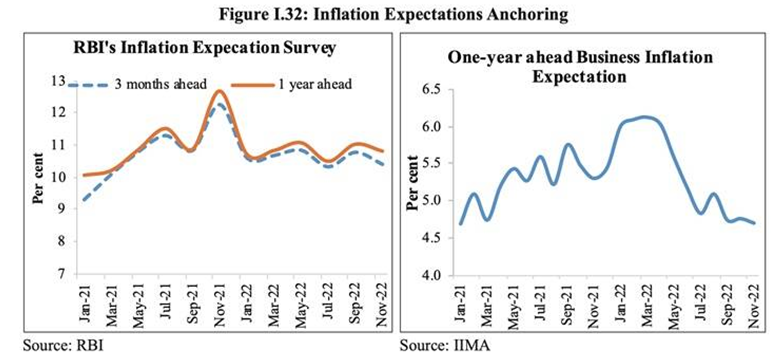
- Inflation:
- Although the RBI has projected headline inflation at 6.8% in FY23, the Survey sounded optimistic about the inflation levels and trajectory.
- Unemployment:
- Highlighted an increase in employment levels in the current FY with greater job creation with the initial surge in exports, a strong release of the “pent-up” demand, and a swift rollout of the capex.
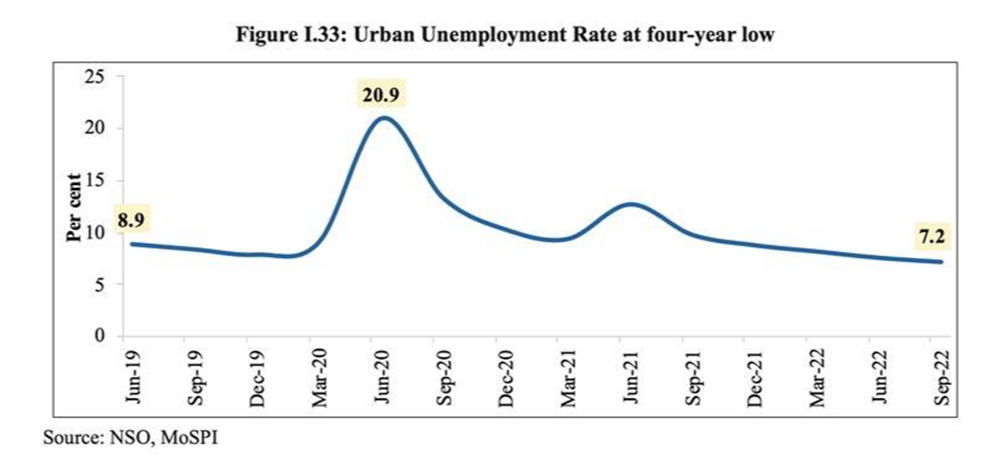
- Periodic Labour Force Survey (PLFS) showed that urban unemployment rate for people aged 15 years and above declined from 9.8% in 2021 to 7.2% in 2022.
- Also underlines an improvement in the labour force participation rate.
- Outlook for 2023-24:
- Baseline GDP growth of 6.5% in real terms in FY24.
- Low demand for Indian exports due to poor global growth
- Widening of India’s trade deficit and make the rupee depreciate.
- Sustained monetary tightening (higher interest rates) may drag down economic activity in FY24.
What does it mean for India’s economy?
- India’s economy has recovered from the Covid disruption and is poised to see sustained robust growth in the rest of the decade.
- Despite the structural and governance reforms that strengthened the economy’s fundamentals by enhancing its overall efficiency, these reforms had not yielded the desired results because:
- NPA’s with Banks
- Deleveraging business firms
- Global Shocks such as the Covid pandemic and the Ukraine war
- Expected a better growth than pre-pandemic years similar to growth experienced in 2003.
What is the reference to 2003?
- Highlighted similarity between the situation in 2023 and 2003.
- Period between 2014 and 2022 is analogous to 1998-2002, when despite transformative reforms by the government, the Indian economy lagged growth returns due to:
- US sanctions after India’s nuclear test
- Two successive droughts,
- The collapse of the tech boom
- But once these shocks faded, the structural reforms paid growth dividends from 2003. The Survey claims the same story is set to repeat from 2023.
- How likely is this?
- Before Covid, India’s potential growth rate had fallen to just 6% from 8% in 2003-2008 period.
- During the 2003-2008 phase, the global economy was booming — exactly opposite of the situation now.
- In India, unemployment rates underestimate the alarming stress in the labour market, because labour force participation rate is itself quite low.
Conclusion:
- India is the world’s most populous country with a growing youth bulge. It has the world’s largest pool of poor people and the largest pool of malnourished children.
- Given the low levels of per capita income, it requires much faster growth than many developed countries.
Prelims Takeaways:
- Highlights of Economic Survey 2023
- Growth rate, Inflation and Unemployment