


Let's plan a path to net zero
- India's per capita emissions are relatively low (1.8 tons of CO2e per person), but we are still the world's third- largest single emitter.
- India goal to become net zero by 2070 can only be met with urgent actions in this decade, potentially accelerated through India's recently-assumed G20 presidency.
- Reaching net-zero could benefit India through lower-cost energy, greater energy security and the growth of futuristic industries.
India's Current Situation
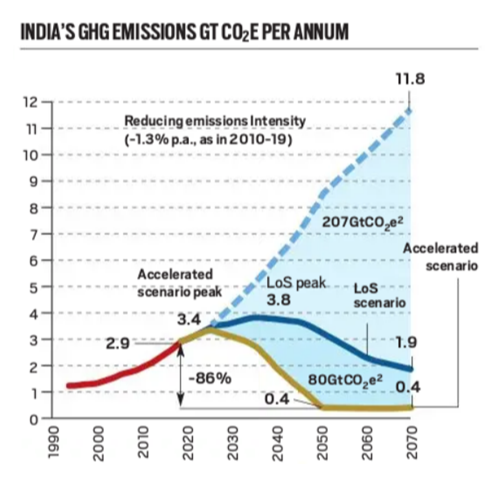
- Current trajectory: India's emissions are set to grow from 2.9 Gt CO2e a year to 11.8 GtCO2e in 2070.
- McKinsey report: Effective decarbonisation, down to 1.9 GtCO2e by 2070, would require India to spend a total of $7.2 trillion on green initiatives by 2050.
- Decarbonisation would require $12 trillion in total green investments by 2050.
- Under this scenario, India could create 287 gigatonnes (GT) of carbon space for the world.
- An orderly transition to net zero could help India decarbonise while creating an engine for growth.
- E.g.: If India shifted to a predominantly renewable (and hydrogen) -based energy and materials system, it could save as much as $3 trillion in foreign exchange by 2070 (largely crude oil and coking coal).
- Futuristic investment will need India to take urgent actions in this decade on regulation, technology development, and on technology adoption - to make the right investments.
- In renewable power, the right policies, strong institutions and industrial capabilities built in the last decade are providing India with the base to scale up four to five times in this decade.
Necessary steps need to be taken for the path of Decarbonisation
Set out national decarbonisation plans
- If we do not act now, more fossil fuel-driven infrastructure will be built, locking India into higher emissions for decades.
- Without decarbonisation plans, it is possible that companies do not invest enough in building capacity, thus leading to shortages, inflation and greater import dependence in other words, a disorderly transition.
- As, the green route requires higher upfront investment and will also sometimes cost more overall.
- Yet, policies that enable carbon prices or blending mandates can make the economics viable.
- Such policies need to be held steady and require coordination across sectors like power, hydrogen and steel
- A national decarbonisation plan would enable timely investment decisions.
Second, A national land use plan.
- India risks being land-short for its dual goals of growth and decarbonisation.
- India would need to maximise the use of barren land for renewable power, urbanise vertically, improve agricultural productivity, and increase forest density.
- This forms the case for establishing a national authority, in consultation with the states, to set land-use guidelines
Third, accelerate compliance with carbon markets.
- Pricing carbon creates demand signals that accelerate emissions reductions, especially in hard-to- abate sectors.
- Eg: Demand for steel could multiply eight times by 2070; right now, much of the new capacity is likely to be added using high-emission coal.
- With a price on carbon emissions, more expensive green steel becomes competitive against high- emission steel.
Way forward
- Companies can invest in opportunities like recycling, hydrogen, biomass, electrolysers, rare earths, battery materials and battery making.
- Some of these opportunities would take time to mature. Meanwhile, companies could invest in opportunities opened up by decarbonisation of other countries, such as exporting green hydrogen derivatives like ammonia.
- Therefore, to embark on an orderly path to net zero, India needs imagination, realism, determination - and a sense of urgency.
- We must take steps this decade to set things up, to establish momentum, and to build India right for generations to come.