

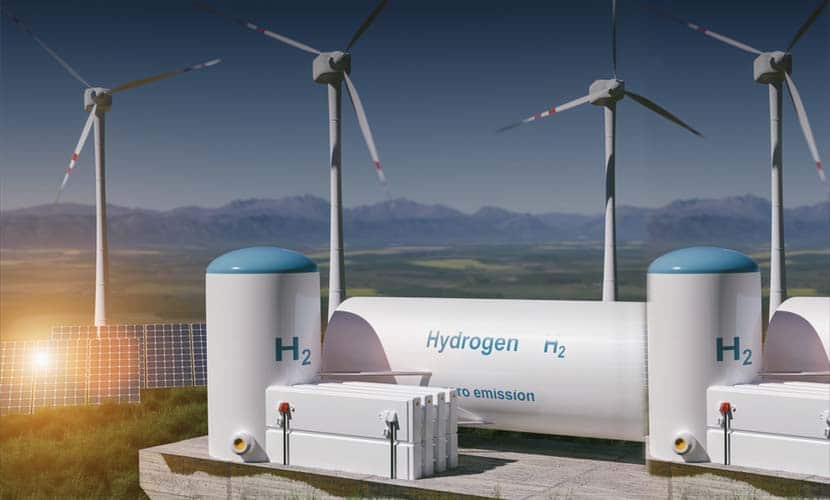
How to become a green hydrogen superpower
- The Union Budget 2023-24 has allocated approximately ₹19700 crores for the National Green Hydrogen Mission.
- Greenhouse gas emissions in India are majorly sourced from steel, cement, fertilizers, and the petrochemical industry.
- Green hydrogen can fuel industrial growth and reduce industrial emissions.
- It can serve as an energy source (heavy industry, long-distance mobility, aviation, and power storage) and an energy carrier (as green ammonia or blended with natural gas).
India Aim
- India aims at least five million tonnes of production by 2030. It is larger than that of any single economy.
- It would further create a demand for 100-125 gigawatts (GW) of renewable energy, 60-100 GW of electrolyzers, an investment opportunity of ₹8 lakh crore, and reduce 50 MMT of annual emissions.
- India can become one of the lowest-cost producers of green hydrogen due to solar and wind energy.
Five Priorities to become Green Hydrogen Superpower:
- Critical domestic demand
- The Strategic Interventions for Green Hydrogen Transition (SIGHT) fund has been introduced for five years, with ₹13000 crores as direct support to consume green hydrogen.
- This would help in increasing the demand of industries and reduce prices.
- Blending targets can also increase demand further.
- One way to leverage domestic demand is government procurement.
- India can also utilize it to become a green steel producer, as India is the second-largest steel producer in the world and the cost of green steel is also very high.
- Attract domestic and foreign investment.
- Low numbers of green hydrogen projects compared to other advanced economies.
- Envisions green hydrogen hubs to consolidate production, end-use, and exports. It will also streamline project clearance and reduce financial risks.
- Manufacturing components of electrolysers.
- Under the Performance Linked Incentive Scheme, the SIGHT fund allocated nearly ₹4500 crores to support electrolyser manufacturing.
- It is important to become more competitive with targeted public funding as China has the potential for 38% of electrolyser capacity by 2030.
- The technology should be improved such that electrolysers become more efficient, substitute critical minerals, and use non-freshwater sources.
- Establishing bilateral partnerships
- Sales to Japan or the EU (in yen- or euro-denominated loans) can reduce the cost of capital and increase export competitiveness.
- India should also cooperate with like-minded countries on trade, value chains, research and development, and standards.
- It should be noted that the mission has allotted around ₹400 crores for R&D.
- Private companies should also consider joint projects in renewable energy and cheap finance.
- Coordination with major economies
- Indian ambitions are at risk due to conflicting regulations and protectionist approaches of major economies.
- Thus rules and standards should be made through structured intergovernmental processes.
- India’s G20 presidency should be used as an opportunity to make rules and address operational threats, industrial competitiveness, and strategic risks.