

Forest fires’ frequency, intensity went up in past 2 decades: study
- The frequency and intensity of forest fires and the number of months in which such fires occur, have increased in the past two decades, according to a study released by Council on Energy, Environment and Water (CEEW).
- The study, ‘Managing Forest Fires in a Changing Climate’, found that there has been a ten-fold increase in forest fires in the past two decades, and that more than 62% of Indian states are prone to high-intensity forest fires.
Key Findings of the Report
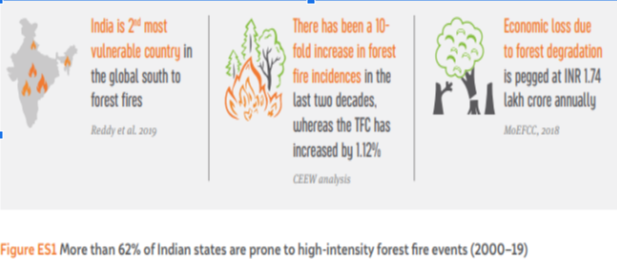
- More than 62 % of Indian states are prone to high-intensity forest fire events.
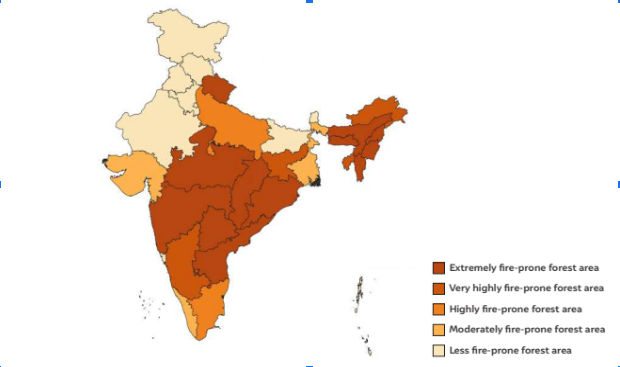
- Extreme forest fire-prone states (2000-19): Andhra Pradesh, Assam, Chhattisgarh, Odisha, Maharashtra, Madhya Pradesh, Manipur, Mizoram, Nagaland, and Uttarakhand .
- Most impacted states: Odisha, Madhya Pradesh, Chhattisgarh
- Most impacted districts: Gadchiroli, Kandhamal and Bijapur.
- 10-fold increase in forest fire incidences in the last two decades.
- Total forest cover (TFC) has increased by 1.12%.
- Frequency of forest fire incidents has increased by 52 %.
- More than 89% of the forest fire hotspots lie in Cwa zones— which have at least ten times as much rain in the wettest month of summer than in the driest month of winter — and Aw zones — which have a pronounced dry season, with the driest month having precipitation of less than 60 mm — climate zones.
- More than 30% of Indian districts, home to over 275 million people, are extreme forest fire hotspots.
- Further, more than 68% of Indian districts witness extreme drought or drought-like conditions and 89% of the forest fire extreme hotspot districts are located in these regions.
| Decade(s) | State hotspots | District hotspots |
|---|---|---|
| 2000-19 | Andhra Pradesh, Assam, Chhattisgarh, Odisha, Maharashtra, Madhya Pradesh, Manipur, Mizoram, Nagaland, Uttarakhand | Dima Hasao, Lunglei, Lawangtalai, Mamit, Harda, Jabalpur, Hoshangabad, Narayanpur, Udham Singh Nagar, Kandhamal, Garhchiroll |
- The analysis also highlights the existence of a distinct ‘fire season’ between February and May.
- There has been a 14-time increase in forest fire alerts in the last six years and forest fire alerts have tripled in number in 2020–2021.
Forest fire proneness criteria:
| Category | Range |
|---|---|
| Extremely fire-prone forest area | Average frequency of forest fires 24 in a grid per year |
| Very highly fire-prone forest area | Average frequency of forest fires (22 and < 4) in a grid per year |
| Highly fire-prone forest area | Average frequency of forest fires (21 and < 2) in grid per year |
| Moderately fire-prone forest area | Average frequency of forest fires(20.5 and < 1) in grid per year |
| Less fire-prone forest area | Average frequency of forest fires (< 0.5) in grid per year |
Improving forest-fire management
- Recognise forest fires as a disaster type and integrate them into national, sub-national and local disaster management plans:
- The National Plan on Forest Fires was launched by the Government of India in 2018 under the flagship National Afforestation Programme.
- This plan touches upon a wide range of activities, but financial constraints and operational dynamism remains a challenge.
- Develop a forest fire-only alert system:
- Currently, Forest Survey of India (FSI) and National Remote Sensing Centre (NRSC) use MODIS and Suomi NPP VIIRS information for near real-time monitoring of forest fires which does not segregate forest fires, waste burning, and crop burning – and hence, ground validation takes time and there is scope for misinformation.
- Enhance adaptive capacity:
- Capacity-building initiatives targeted at district administrations and forest-dependent communities can avert the extent of loss and damage due to forest fires.
- Training on high technology-focused equipment (like drones) and nature-based modules (e.g. creating effective forest fire lines) can effectively mitigate the spread of forest fires.
- Provide clean air shelters:
- The state government/ state forest departments (SFDs) should repurpose public buildings like government schools and community halls by fitting them with clean air solutions – like air filters – to create clean air shelters for communities worst impacted by fires and smoke from forest fires.
Conclusion
- Among the countries of the global south, India is one of the most vulnerable nations and is exposed to an increasing trend of forest fires. India is aggressively marching ahead to achieve its NDCs and enhance its carbon sink; the likelihood of it achieving its Bonn challenge commitment of restoring 26 million hectares of degraded forests looks blurry, especially considering the soaring 10-fold increase in forest fire incidences over the last two decades. Adhering and applying principles of risk assessment for the effective management of forest fires can help climate-proof forests.
About Council on Energy, Environment and Water (CEEW)

- The Council on Energy, Environment and Water, commonly known as CEEW, is a Delhi-based not-for-profit policy research institution.
- Some of CEEW’s research areas include resource efficiency and security; water resources; renewable energy; sustainability finance; energy-trade- climate linkages; integrated energy, environment and water plans; and climate geoengineering governance.
- The think-tank advises the Indian government on matters related to environment and energy.
Exam Track
Prelims Takeaway
- Council on Energy, Environment and Water (CEEW)
- Forest fire proneness criteria
Mains Track
Q. Forest fires are extremely detrimental to the already deteriorating air quality and also the flora and fauna living there. Discuss in light of the latest released report of CEEW and suggest some ways of improving forest fire management.