

Archaeologists come up with rare findings in Tamil Nadu
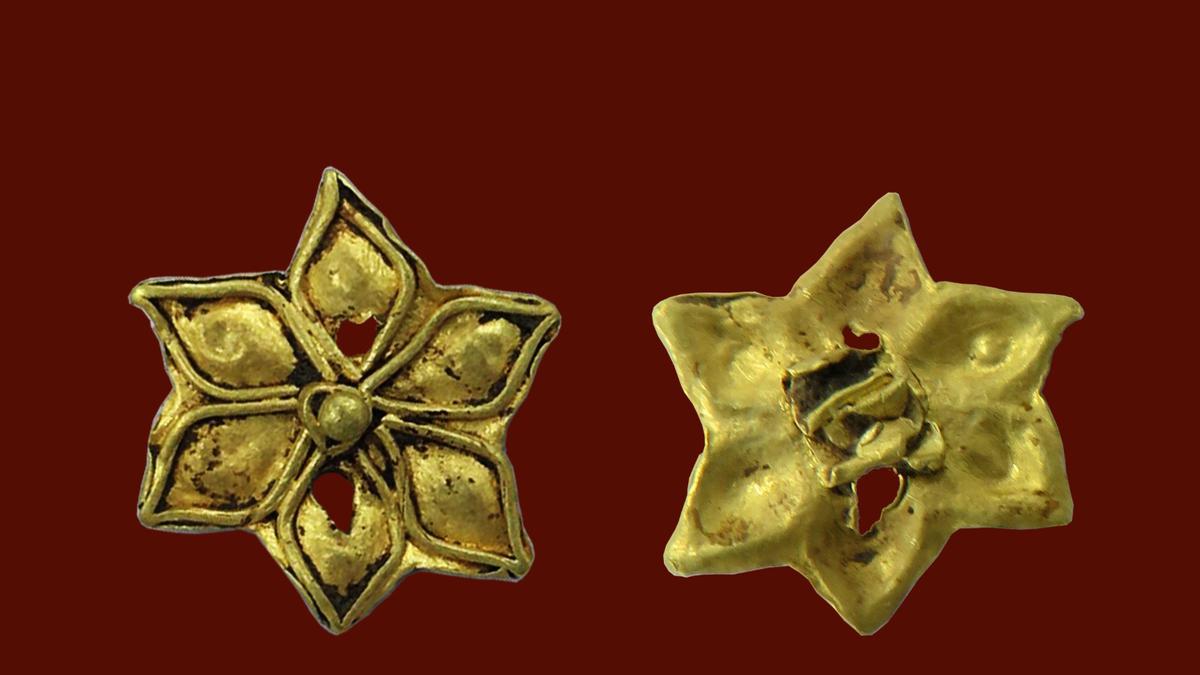
- Recently, a gold stud, a bone point and a carnelian bead have been unearthed by archaeologists at Porpanaikottai in Pudukkottai district of Tamil Nadu
- A Sangam-age fort is believed to have existed at the site.
Key Findings
- The stud in floral design with six petals was probably used as a nose stud
- It is an indication of the culture of the Sangam Age
- The bone point with pointed ends on both sides and carvings, was probably used for weaving
- The discovery of the red round-shaped carnelian bead is a pointer to domestic trade.
- Carnelian beads have been found at Kodumanal and a few other places in Tamil Nadu.
- The stones were usually sourced from Gujarat
Porpanaikottai
- Porpanaikottai, situated about 6.5 km to the east of Pudukkottai town, is one of the new sites where the department had taken up excavation this year.
- Studies carried out at the site using Light Detection and Ranging (LIDAR), a remote sensing method, had indicated that a fort existed at Porpanaikottai.
- A habitation mound spread over 1.26 hectares is believed to have existed within the fort.
- A three-course brick structure was unearthed within a few days of digging.
- Over 150 antiques, including potsherds, hopscotches, spouts, pieces of glass bangles and beads, a terracotta lamp, a coin, a spindle whorl and rubbing stone, besides a couple of graffiti, have been found at the site so far.
Sangam Age
- The period roughly between the 3rd century B.C. and 3rd century A.D. in South India (the area lying to the south of river Krishna and Tungabhadra) is known as Sangam Period.
- It has been named after the Sangam academies held during that period that flourished under the royal patronage of the Pandya kings of Madurai.
- South India, during the Sangam Age, was ruled by three dynasties-the Cheras, Cholas and Pandyas.
- The main source of information about these kingdoms is traced from the literary references of Sangam Period.
- According to the Tamil legends, there were three Sangams (Academy of Tamil poets) held in the ancient South India popularly called Muchchangam.
- The Sangam literature includes Tolkappiyam, Ettutogai, Pattuppattu, Pathinenkilkanakku, and two epics named Silappathikaram and Manimegalai.
Prelims Takeaway
- Sangam Age
- Archaeological Survey of India
- Location related Questions