

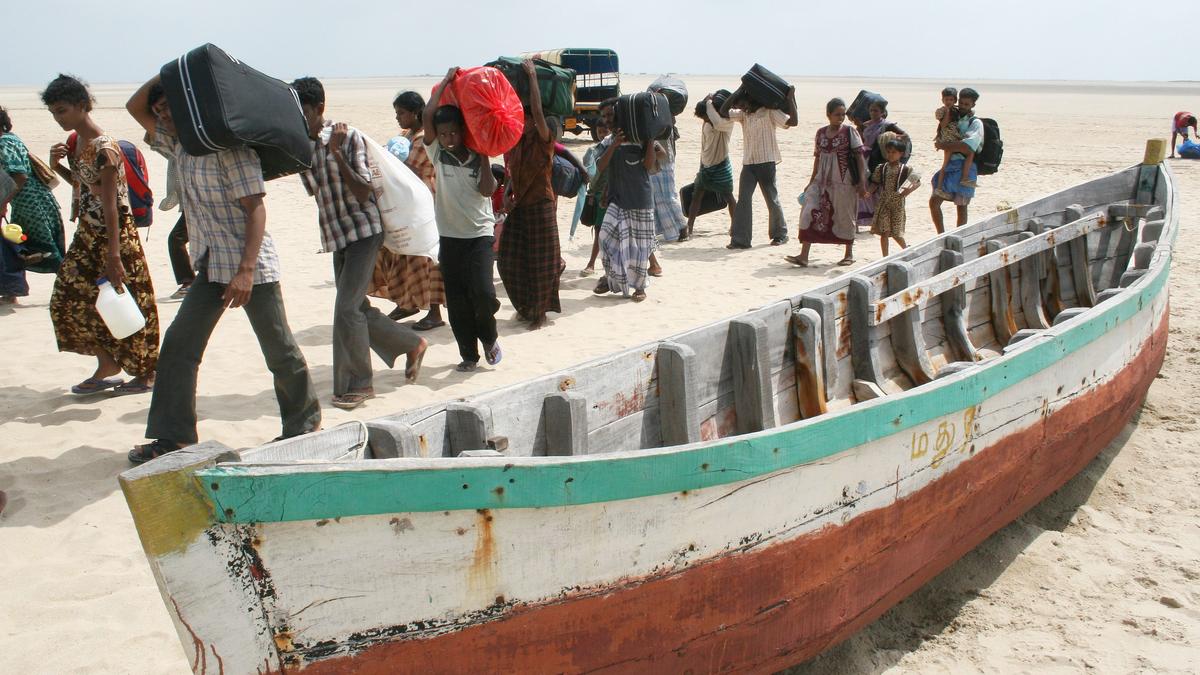
A story of displacement to one of empowerment
- The Sri Lankan Tamils who arrived on the shores of Tamil Nadu, India, for the first time in 1983 had lost everything.
- Their only objective was to save their lives from the hate-filled ethnocentric violence which caused their displacement.
- Most vulnerable Sri Lankan Tamils chose India due to its proximity, accessibility and linguistic commonality of Tamil.
- Since 1983, 3,34,797 Sri Lankan Tamils have sought refuge in Tamil Nadu.
- They came in four phases that coincided with the escalation of conflict in Sri Lanka since 1983:
- Currently, there are 57,975 refugees living in 105 government-run camps in Tamil Nadu and an estimated 40,000 Sri Lankan Tamils living outside the camps in Tamil Nadu with police registration
New beginnings
- The lifestyle of these populations underwent a drastic change.
- They had to get attuned to a new life of living in isolated camps in different locations.
- However they receive several benefits in these camps such as free housing, electricity, water and monthly food rations.
- They also have access to all the welfare schemes available to the people of Tamil Nadu including the latest women’s rights scheme of ₹1,000 per month.
- In terms of education, the refugees have access to government schools, and receive the additional benefit of ₹1,000 a month if they progress to higher education.
- There are also specific one-time education support programmes that are available to refugees, arts and science college students get ₹12,000 and students of engineering courses get ₹50,000.
- Most recently, the Government of Tamil Nadu has handed over brand new homes to about 5,000 Sri Lankan Tamils.
- A costing study that was completed in end-2023 documented that the government spent about ₹262 crore on refugees annually.
Bringing back dignity
- The welfare schemes form a large part of the protection of the Sri Lankan Tamils to restore their dignity and empower them to build a sustainable future.
- This has resulted in 100% enrolment in schools and over 4,500 graduates from the camps. They have been able to break free of their caste barriers as they fall under the Refugee category.
- The treatment of the Sri Lankan refugee is significant because India is not a signatory to the Refugee Convention of 1951 and has absence of domestic laws to govern refugees.
- Having lived in India for over two generations, the refugees have constantly empowered themselves with experience and education.
- Since the end of the war in Sri Lanka in 2009, a total of 16,641 refugees have returned to Sri Lanka according to the UNHCR. While the momentum to return was picking up at a steady pace, the COVID-19 pandemic, and thereafter the economic crisis in Sri Lanka, paused and later slowed down the process.
- The story of the Sri Lankan refugee living in the welfare centres of Tamil Nadu is one of a refugee-care model that is to be emulated.
- the Sri Lankan Tamils living in the welfare centers has resulted in a transformation story
- of helpless refugees turning into resource persons who could potentially contribute to the rebuilding of the nation when they return.
- They will also form the most important skilled human resource that is ready to take up any challenge as it arises.